

Construction Risk Management
Construction Risk Management - Construction Process Management
The construction and civil engineering industry is characterized by projects with delayed schedules and budget overruns, and the quality sometimes fails to meet expectations. The challenge is particularly pronounced in mega-projects. So, if you're building something significant, the odds are stacked against you. 9 out of 10 mega-projects go over budget, and overruns of 50% or more are pretty standard - and Danish mega-projects are no exception.
Many of the underlying causes of challenges stem from decision-making processes, competencies, and management methods. If you want to explore the topic further, we’ve gathered a selection of articles that shed light on why megaprojects so often run into difficulties. Even if your project doesn’t fall into the “megaproject” category, these articles still provide valuable insights into the typical challenges and dynamics that apply to large-scale projects.
Megaprojects are constantly “Over budget, over time, under benefits, over and over again”
– Iron Law of Megaprojects, Bent Flyvbjerg 2011.
Top Ten Behavioral Biases in Project Management: An Overview, Bent Flyvbjerg 2021.
Data-Driven Project and Risk Management in Construction
If you are interested in completing your project, we have developed a data-driven method for project and risk management. Our risk management differs from traditional approaches by being based on facts, without subjective assessments, and it is time-efficient to implement, as reporting and analysis are largely automated.
You know where your project stands about the plan daily, and risks can be mitigated promptly.
5 Steps for Project and Risk Management at Exigo
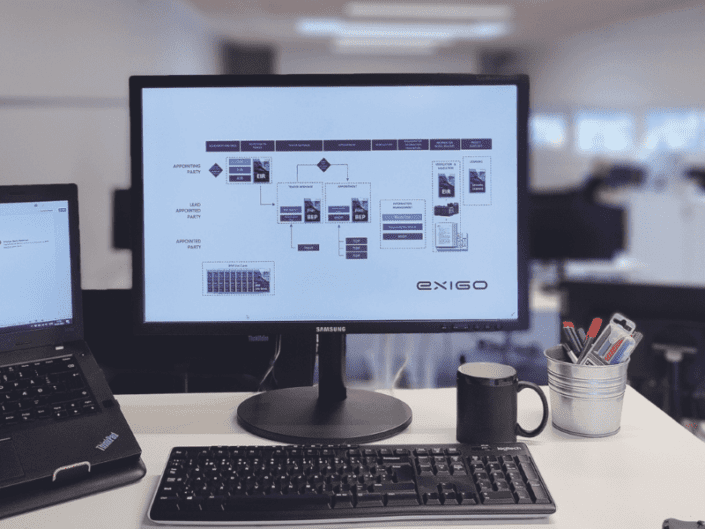
What is BIM Process Management?
BIM Procesledelse omfatter definering af mål, omfang og workflow for implementeringen af BIM metoder i et projekt. Dette beskrives i dokumenter som IKT-aftaler, Procesmanualer og Leverancespecifikationer eller Employer’s Information Requirements (EIR), BIM Execution Plan (BEP) og Task Information Delivery Plans (TIDP) med flere iht. ISO 19650. Dokumenterne skal skal afstemme informationskrav til data og geometri, digitale leverancer, udviklingen af dem gennem projektets faser, og hvem der er ansvarlige for hver enkelt leverance og fag.

2) Design Phase
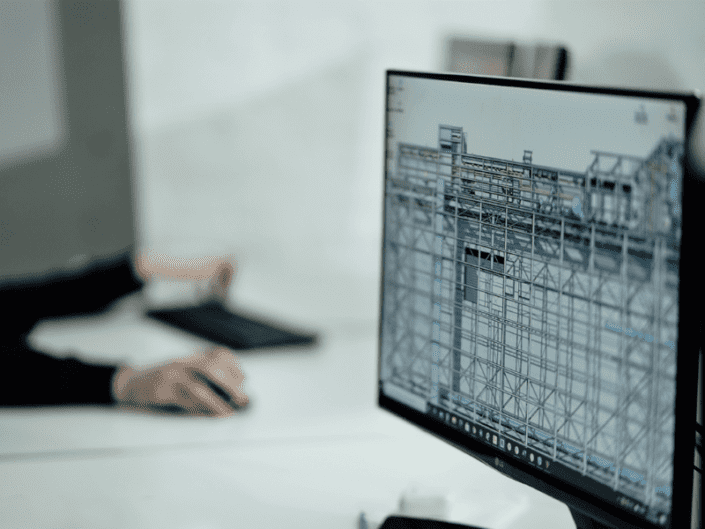
Before construction commences, it's essential to thoroughly quality control all the 3D building models related to your project. This applies to the individual 3D building models and the interdisciplinary federated model, a collection of 3D models from all disciplines. Are the models geometrically correct? Are they named correctly? Has continuous clash detection been performed across disciplines?
In simple terms, your project should be able to be flawlessly built on the computer screen before starting the project in reality. If that's not the case, you should wait until the entire project is ready. It can be costly to rectify clashes on the construction site.
We assist you in ensuring that the 3D models, and thus the project material that forms the basis of the construction process, are of high quality, significantly reducing your risk of additional costs during execution.
Read more about our Collision Control and Constructability Analyses
Why is constructability so important?
Research shows that the most crucial key to keeping costs down is to make the implementation phase as short and delays as small as possible [Flyvbjerg, 2017]. This can be ensured through prefabrication, standardization, and modularization. However, it is also essential that the project material is well-coordinated and, therefore, constructible within the planned implementation phase.
Why is a realistic plan for the entire project important – it won't hold anyway, will it?
The planning effort results in establishing both the formal performance baseline and the legal contract scope and insurance [Gil & Pinot, 2018]. Furthermore, planning mega-projects often tend to be overly optimistic, with limited learning from other mega-projects. It thus does not allow for sufficient unforeseen events of complexity and unplanned incidents [Flyvbjerg, 2017]. To handle the unforeseen, it's important to have a plan where consequences can be quickly understood in detail. It is, therefore, crucial to use a structured data-driven approach to break down the work and estimate the duration of activities. This is done by basing the execution planning on quantities distributed at locations and involving the contractors with deep domain expertise.

4) Execution Phase
Real-time cost and time control based on earned-value management, state registration, and management reporting with online dashboards.
During the execution phase, we continuously monitor whether your project progresses according to the plan. As soon as a deviation is identified, we ensure that corrective actions are taken immediately to minimize the consequences of the variations on the project.
How is financial management implemented with Earned Value Management?
Økonomistyringen udføres ved hjælp af den lokationsbaserede tidsplan, der giver en let forståelig struktur til fordeling af omkostninger. Optimalt baseret på mængder fra en 3D-model, men ellers beregnet manuelt.
By “cost-loading” the location-based schedule, you establish the foundation for automatically calculating the planned cash flow. When progress is entered for each activity at the individual locations, the actual value created on-site becomes visible. This makes it easy to compare with the monthly progress reports from contractors, site teams, and subcontractors. In this way, the “Earned Value Management” method is applied to monitor and assess risks in project progress. With Tactplan Control, this can be done in just a few minutes daily or weekly - even for very large projects.
Real-time progress reporting also ensures that project payments reflect the actual work performed on-site, so the total project payout at any given time matches the total earned value of the completed work.

What competencies do I need?
With the right methods—such as location-based scheduling in Tactplan Schedule combined with progress tracking and management reporting in Tactplan Control—even very large projects can be managed by just 1–2 people. However, this requires the right competencies. The individual steps in Exigo’s project and risk management method are simple to understand and learn. The challenge lies in making it work with fully integrated real-time data on actual projects. That’s why we recommend involving us in your first project—after that, with the right effort, you can become self-sufficient on the next one.
Construction Risk Management – We are also happy to assist you.
A lot is happening in risk management and digitalization, and plenty of opportunities. Many opportunities. Therefore, it can be challenging to see which pots at the end of the digital rainbow contain gold.
At an informal meeting, we offer our expertise and insights tailored to your company's specific needs.
Write or call Kristian Ekkersgaard ke@exigo.dk, 53 55 59 05 she will find a date in the calendar for you.
If, as a developer, you don't ensure that construction management and contractors have robust planning and management tools, you can't expect them to deliver good results. I see Exigo as part of my construction management. The Exigo team has expertise in location-based planning coupled with finance and 3D (4D+5D), and they have the experience, tools, and processes to perform that work precisely. The rest of my construction management and other consultants must gain that expertise. The advice and means I get from Exigo are precisely what I need to ensure that my construction management and contractors can plan and manage the project and deliver the desired results.